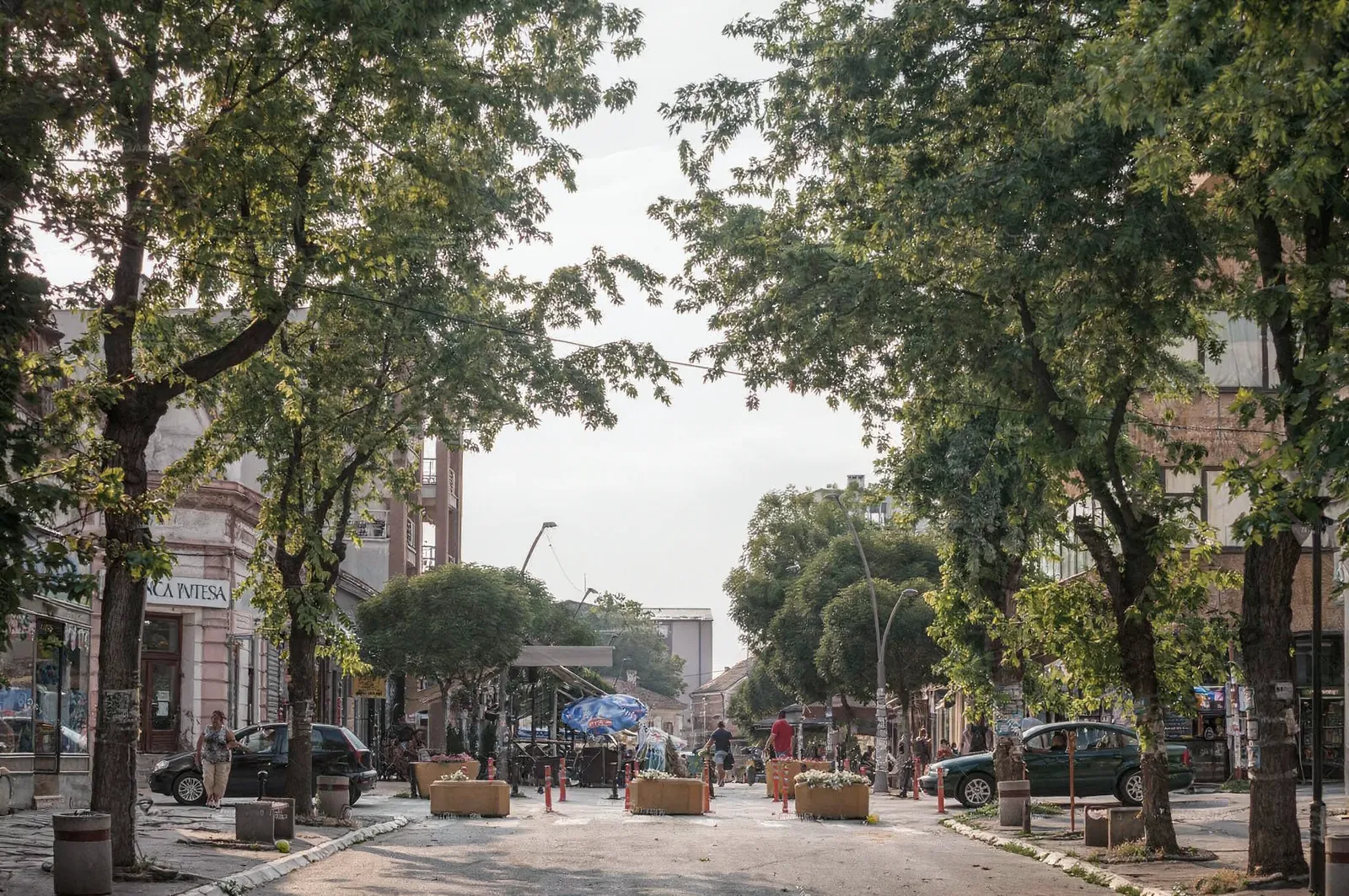
About Palanka
A short, verified history of Smederevska Palanka — from its first mention to the industrial age.
- Origin of the name
- „palanka“ = a palisade fort (Gr. phalanx)
- First mention
- 1020/1021, as Bela Crkva
- Administrative district
- Podunavlje (the Jasenica region)
- River
- Jasenica (with the Kubršnica)
- Population 2022
- town 20,345 · municipality 42,192
- Distance from Belgrade
- ≈70 km
- Railway
- first train 1884 (Belgrade–Niš)
- The „Goša“ factory
- founded 1923 (as AD „Jasenica“)
Origin of the name
The word „palanka“ denotes a smaller fortified settlement ringed by a palisade — a wall of upright, sharpened stakes driven into the ground, with a ditch and an earthen rampart. The root is derived from the Greek φάλαγγα (phalanx — „stake, log“), by way of Latin. Forts of this kind spread across the Balkans in the late Ottoman period, along the important roads.
The early settlement
The settlement on the site of today's town is first mentioned in the year 1020 under the name Bela Crkva, in a charter of the Byzantine emperor Basil II (some sources give the year 1021). At the beginning of the 15th century Nekudim, the summer residence of Despot Đurađ Branković, stood nearby.
The Ottoman period
With the arrival of the Ottomans the settlement took the name Hasan Pasha's Palanka — a fortified palanka on the imperial road from Belgrade to Constantinople. Later it was called simply „Palanka“, and only after the Second World War Smederevska Palanka.
The First and Second Serbian Uprisings
The place is closely tied to the beginning of the uprising: on 4 March 1804 it was in Hasan Pasha's Palanka that Karađorđe negotiated with the envoys of the dahije. In the autumn of 1809 he held the so-called „small assembly“ here. Stanoje Stamatović Glavaš, a hero of the First Serbian Uprising, was born in nearby Glibovac.
Development in the 19th century
More intensive development began in the last quarter of the 19th century, when the oldest railway in Serbia (Belgrade–Niš) was laid through Palanka. The first train passed in 1884, which decisively accelerated economic and urban growth.
The „Goša“ factory
The town's most important enterprise was founded in 1923 as AD „Jasenica“, with Serbian and French capital, for railway carriages and steel structures. It bears the name „Goša“ after the national hero Dragoslav Đorđević Goša. „Goša“ was one of the largest enterprises of the former Yugoslavia and the foundation of the town's industrial development.
The coat of arms and the name of the town
The oldest name of the place — Bela Crkva („white church“) — lives on today in the municipal coat of arms: the shield bears a silver (white) church, together with a palisade line recalling the origin of the word „palanka“ and a golden wavy bar that heraldically represents the river. Besides the town, the municipality is made up of 17 villages.
Sources: Wikipedia (sr/en), the official municipal website, the National Library, Goša FOM. Some dates (e.g. the first mention 1020/1021, the founding of „Goša“ 1923/1930) differ between sources and are given with that caveat.